
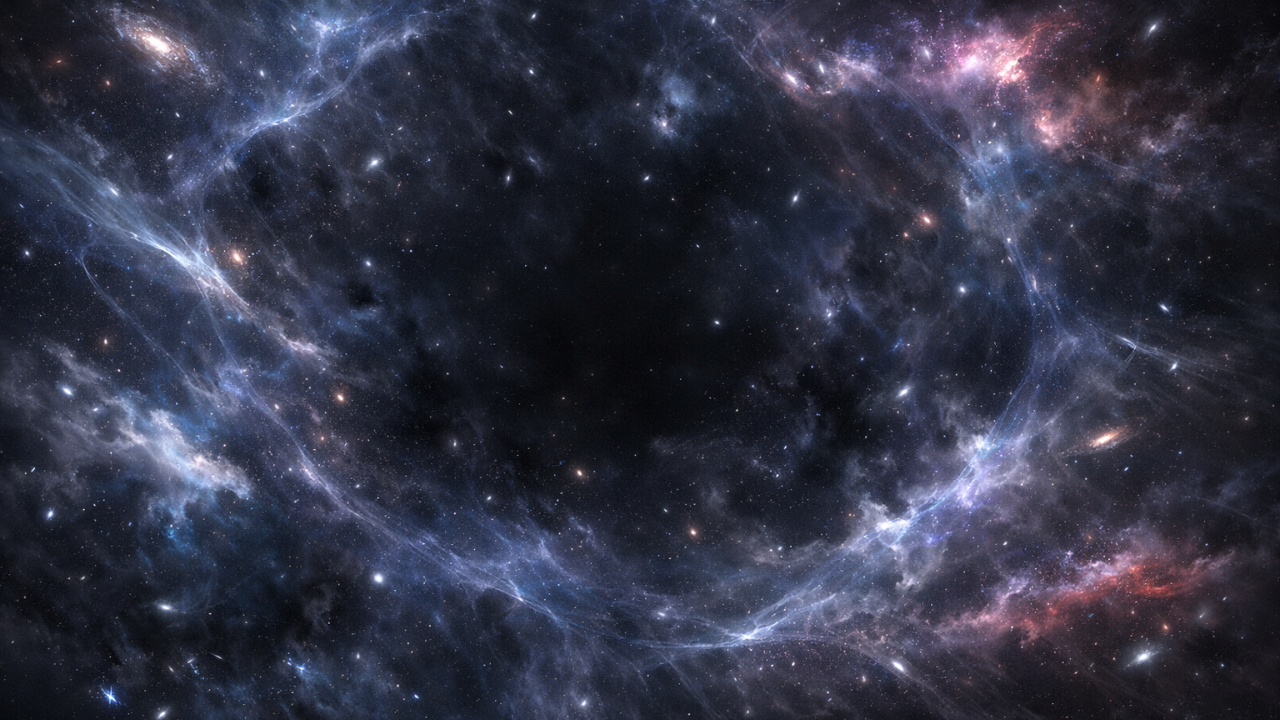
When we look at the universe, we often picture stars, planets, and galaxies filling every corner. Yet, cosmic voids are enormous regions of space where matter is extremely sparse. Despite their name, these voids are not truly empty. T
hey contain mysterious forms of energy and quantum phenomena that challenge our understanding of the cosmos. Studying these regions helps scientists explore the fundamental forces shaping the universe.
What Cosmic Voids Contain
Contrary to the idea of emptiness, cosmic voids are filled with strange and invisible phenomena:
- They have very low densities of matter, often less than one hydrogen atom per cubic meter.
- Vacuum energy permeates these regions, creating a subtle yet powerful effect on space itself.
- Dark energy, the force accelerating the universe’s expansion, is most prominent within voids because there is little matter to counteract it.
- Traces of dark matter may exist, influencing the gravitational environment of these seemingly empty spaces.
In essence, cosmic voids are full—not of galaxies or stars—but of energy fields and forces that shape the cosmos.
The Size of Cosmic Voids
Cosmic voids are astonishingly large, ranging from millions to billions of light-years in diameter. Below is a table of notable void sizes:
| Void Name | Diameter (Light-Years) | Key Feature |
|---|---|---|
| LOWZ North 13788 Void | ~2.95 billion | One of the largest known voids. |
| Local Hole (KBC Void) | ~2.0 billion | May include our Milky Way region. |
| Giant Void | ~1.3 billion | Contains very few galaxies. |
| Boötes Void | ~330 million | Extremely low galaxy density. |
| Typical Void | 30–300 million | Average size of most cosmic voids. |
These voids are so vast that light from galaxies within them may take millions or even billions of years to reach observers.
Why Cosmic Voids Matter
Even with minimal matter, cosmic voids are crucial for understanding the universe:
- Dark Energy Insights – Voids provide a natural laboratory for studying the effects of dark energy on space expansion.
- Quantum Phenomena – The vacuum inside voids contains quantum fields that form the underlying framework of reality.
- Cosmic Web Formation – Voids influence how galaxies and matter cluster into filaments, walls, and superclusters.
By examining voids, scientists can explore questions about why the universe is expanding and how its large-scale structure evolved.
Cosmic voids may appear empty, but they are far from nothing. Filled with vacuum energy, dark energy, and traces of matter, these regions play a pivotal role in shaping the cosmos. Understanding voids allows us to study fundamental physics, cosmic expansion, and the universe’s hidden architecture, revealing that what seems empty may be among the most intriguing regions of space.
FAQs
What are cosmic voids?
Cosmic voids are vast regions in space with very low densities of galaxies and matter, forming huge empty-like areas between filaments of the universe.
Are cosmic voids really empty?
No. They contain vacuum energy, dark energy, and sparse traces of matter, making them far from completely empty.
Why are cosmic voids important for science?
Studying voids helps scientists understand dark energy, quantum fields, and how galaxies and matter organize in the universe.