


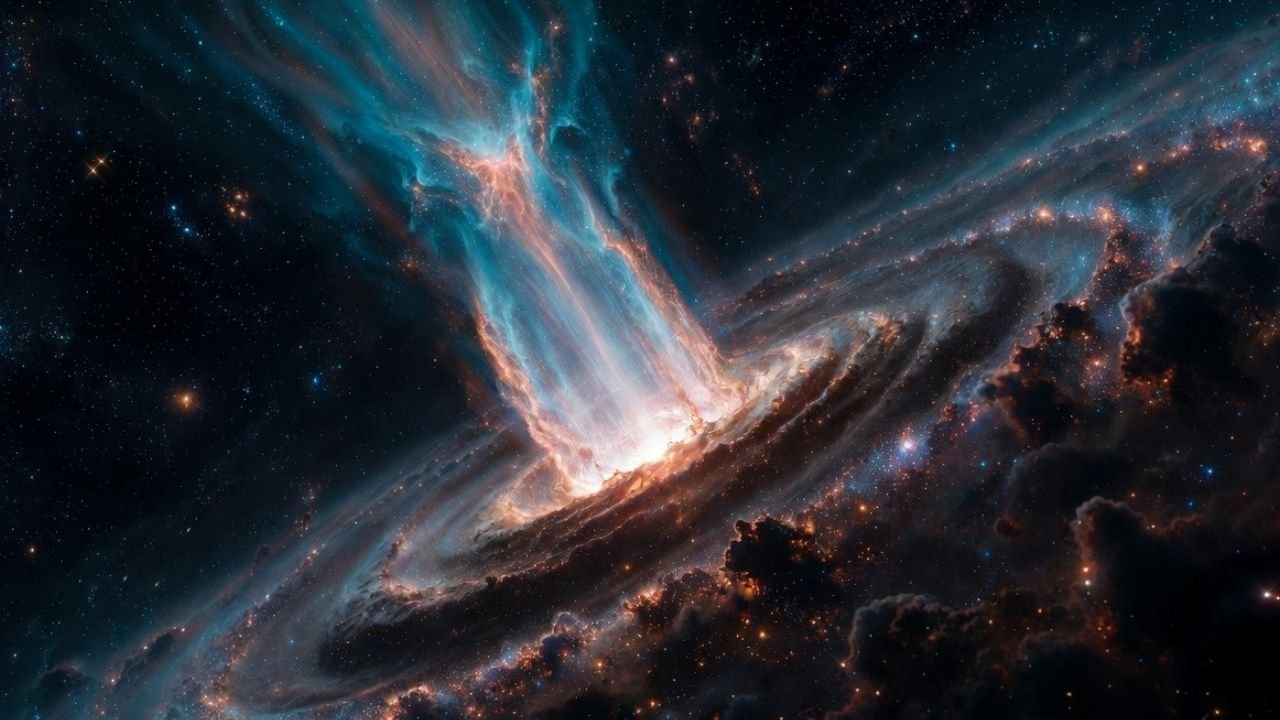
For nearly 100 million years, the massive galaxy J1007+3540 appeared calm and inactive. Its central supermassive black hole showed no strong signs of activity.
But astronomers recently witnessed a dramatic transformation. The black hole suddenly reawakened, erupting like a cosmic volcano and launching powerful plasma jets stretching almost one million light-years across space.
This extraordinary discovery has given scientists new insight into how galaxies evolve and how black holes can switch between long periods of silence and explosive activity.
What Exactly Happened?
At the center of galaxy J1007+3540 lies a supermassive black hole — millions to billions of times more massive than our Sun. For about 100 million years, it remained dormant, meaning it was not actively feeding on surrounding gas and dust.
Then something changed.
Fresh material began falling toward the black hole. As this matter spiraled inward, it formed a rapidly spinning accretion disk. The intense gravitational forces heated the material to extreme temperatures, generating enormous amounts of energy.
This energy powered twin relativistic jets — streams of highly energized, magnetized plasma — blasting outward in opposite directions at speeds close to the speed of light.
These jets now extend nearly 1,000,000 light-years, which is about ten times wider than the Milky Way Galaxy.
Key Facts and Scientific Details
Here is a clear breakdown of the most important data:
| Category | Details |
|---|---|
| Galaxy Name | J1007+3540 |
| Black Hole Type | Supermassive black hole |
| Dormant Period | Approximately 100 million years |
| Jet Length | Nearly 1 million light-years |
| Jet Composition | Magnetized plasma |
| Speed of Jets | Close to the speed of light |
| Detection Method | Radio astronomy imaging |
| Activity Type | Episodic Active Galactic Nucleus (AGN) |
| Scientific Importance | Shows black holes can “switch on” after long inactivity |
How Was It Observed?
Astronomers used advanced radio telescopes, including LOFAR (Low Frequency Array) in Europe and India’s upgraded Giant Metrewave Radio Telescope (uGMRT). These instruments detect radio waves emitted by charged particles in the jets.
The images revealed something fascinating:
- A bright, newly active inner jet
- Older, faint outer lobes from previous eruptions
- Distorted plasma shaped by surrounding hot gas in the galaxy cluster
This layered structure suggests the black hole has gone through multiple activity cycles over cosmic time.
Why Scientists Call It a “Space Volcano”
The comparison to a volcano comes from the sudden, explosive release of energy after a very long quiet phase. Just like Earth’s volcanoes can remain dormant for centuries before erupting, this black hole stayed inactive for 100 million years before dramatically erupting again.
The eruption injected enormous amounts of energy into the surrounding galaxy cluster. This process can:
- Regulate star formation
- Heat intergalactic gas
- Influence galaxy growth
- Reshape cosmic environments
Why This Discovery Matters
This event challenges the idea that black holes are either permanently active or permanently silent. Instead, it confirms that supermassive black holes operate in cycles.
The nearly one-million-light-year jets demonstrate how powerful black holes can be. Their energy output can exceed that of entire galaxies.
The discovery also helps astronomers understand:
- How galaxies evolve over billions of years
- How black holes affect surrounding cosmic structures
- How long dormant phases can last
- How episodic AGN activity shapes galaxy clusters
This is one of the clearest examples of a reactivated black hole ever observed.
The awakening of the supermassive black hole in J1007+3540 after 100 million years of silence is one of the most dramatic cosmic events recently observed. The powerful jets stretching nearly one million light-years show that black holes are not permanently quiet or active — they evolve in cycles.
This “space volcano” eruption provides strong evidence that galaxies are dynamic systems constantly changing over immense timescales. As telescope technology improves, scientists expect to discover even more examples of these sleeping giants suddenly roaring back to life, reshaping the universe around them.
FAQs
What caused the black hole to erupt after 100 million years?
The eruption likely began when fresh gas and dust started falling into the black hole, reactivating its energy production and launching powerful jets.
How large are the jets from this eruption?
The plasma jets extend nearly one million light-years, making them far larger than the host galaxy itself.
Is this a common event in the universe?
Black hole reactivations are rare to observe, but scientists believe many supermassive black holes go through similar episodic activity cycles over cosmic time.