


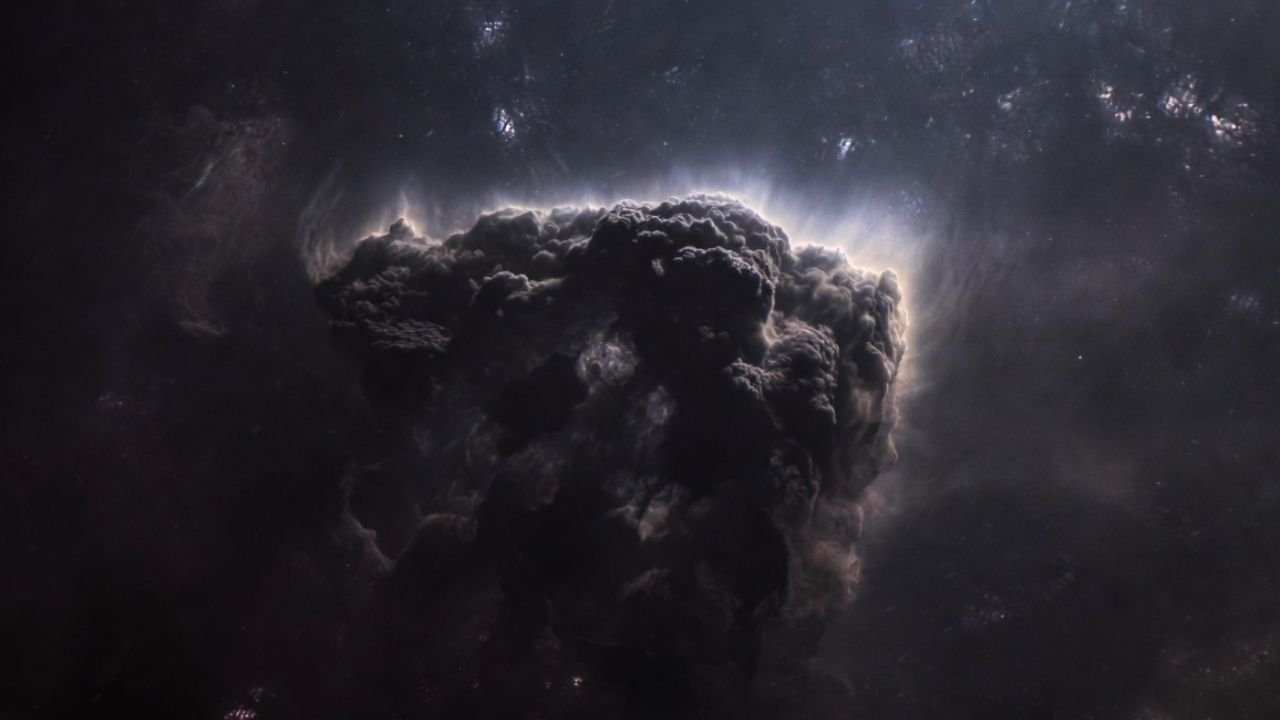
In a surprising and historic breakthrough, NASA scientists have confirmed the discovery of a mysterious starless gas cloud floating in deep space. The object, nicknamed Cloud-9, is being described as a possible “failed galaxy” because it contains gas and dark matter but no stars at all.
This rare discovery is helping astronomers better understand dark matter, galaxy formation, and the early universe.
What Is Cloud-9?
Cloud-9 is a massive cloud of neutral hydrogen gas located about 14 million light-years from Earth. It sits near the spiral galaxy Messier 94 (M94) in the constellation Canes Venatici.
What makes it extraordinary is simple but shocking:
Despite having enough gas to form stars, not a single star has been detected inside it.
Scientists classify Cloud-9 as a Reionization-Limited H I Cloud (RELHIC) — a type of object that was predicted by cosmological models but had never been clearly confirmed until now.
How NASA Discovered the Starless Cloud
The discovery happened accidentally during a large survey of hydrogen gas in nearby space.
Here’s how it unfolded:
- First detected by the Five-hundred-meter Aperture Spherical Telescope (FAST) in China.
- Confirmed through follow-up radio observations using the Green Bank Telescope (GBT) and the Very Large Array (VLA) in the United States.
- Finally observed in detail by the Hubble Space Telescope, which searched for stars inside the cloud.
- Hubble found zero stars — not even faint or tiny ones.
This confirmed that Cloud-9 is truly starless, not just faint.
Key Scientific Facts About Cloud-9
| Feature | Details |
|---|---|
| Name | Cloud-9 |
| Type | Starless gas cloud (RELHIC) |
| Distance from Earth | ~14 million light-years |
| Nearby Galaxy | Messier 94 (M94) |
| Gas Mass | ~1 million times the Sun’s mass |
| Dark Matter Halo Mass | ~5 billion solar masses |
| Stars Present | None detected |
| Importance | First confirmed dark matter-dominated starless object |
Why Is This Discovery So Important?
Cloud-9 is extremely important because it supports the Lambda Cold Dark Matter (ΛCDM) model, which predicts that many small dark matter halos should exist in the universe.
Normally, gas inside a dark matter halo collapses and forms stars. But in Cloud-9’s case:
- The dark matter halo may not have been massive enough to trigger star formation.
- During the early universe’s reionization era, cosmic radiation may have prevented the gas from cooling and forming stars.
- As a result, it remained a dark, invisible structure.
This makes Cloud-9 a kind of cosmic fossil — a leftover building block from the early universe that never evolved into a normal galaxy.
What This Means for Future Space Research
The discovery suggests that the universe may contain many hidden starless clouds that we cannot see using normal optical telescopes.
Since Cloud-9 emits radio signals from hydrogen gas, radio telescopes will play a key role in finding more of these mysterious objects.
This changes how scientists think about:
- Galaxy formation
- Dark matter distribution
- The structure of the local universe
- Early cosmic evolution
Future missions and deeper sky surveys may uncover dozens or even hundreds of similar objects.
Understanding Dark Matter’s Role
Cloud-9 appears to be dominated by dark matter, which does not emit light but makes up about 85% of the universe’s total matter.
Without dark matter:
- Gas clouds would not stay gravitationally bound.
- Galaxies would not form.
- The cosmic web structure would not exist.
Cloud-9 provides a rare opportunity to study a dark matter halo without stars, something astronomers have long searched for.
The accidental discovery of Cloud-9 marks a major milestone in modern astronomy. For the first time, scientists have confirmed the existence of a starless, dark matter-dominated gas cloud predicted by theoretical models.
Located 14 million light-years away, this object challenges our understanding of galaxy formation and reveals that not all cosmic structures succeed in forming stars.
Cloud-9 acts like a time capsule from the early universe, helping researchers study dark matter and cosmic evolution in ways never before possible. As radio astronomy advances, more hidden objects like this may soon come to light, reshaping our understanding of the universe.
FAQs
What is Cloud-9?
Cloud-9 is a massive hydrogen gas cloud that contains dark matter but no stars, making it a rare “failed galaxy.”
How far away is the starless cloud?
It is located approximately 14 million light-years from Earth near Messier 94.
Why did Cloud-9 not form stars?
Scientists believe its dark matter halo was too small to trigger star formation, and early cosmic radiation may have prevented gas collapse.