


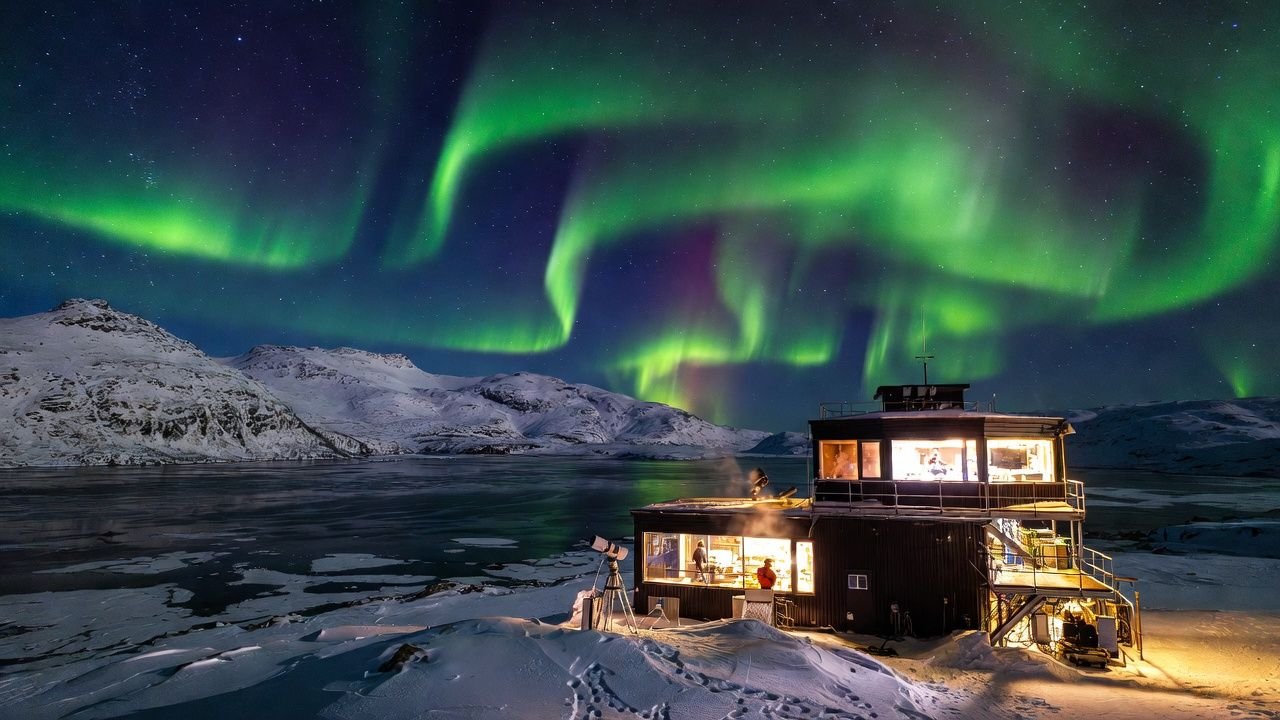
For more than a century, Norway has played a leading role in scientific research on the Northern Lights, also known as the aurora borealis. Because of its location within the Arctic Circle and directly under the auroral oval, Norway has been the perfect natural laboratory for studying this breathtaking sky phenomenon.
Over the last 100+ years, Norwegian scientists have uncovered critical facts about how the lights form, how high they appear, and how they are connected to the Sun’s solar activity and Earth’s magnetic field.
This article explains the complete history, key discoveries, major observatories, and modern advancements in Norway’s century-long aurora research.
What Are the Northern Lights?
The Northern Lights occur when charged particles from the Sun travel through space as part of the solar wind and collide with Earth’s magnetic field.
These particles interact with gases like oxygen and nitrogen in the upper atmosphere, producing glowing colors such as green, red, violet, and blue.
Auroras usually appear at heights between 90 km and 150 km above Earth’s surface, though they can sometimes reach higher altitudes.
The Beginning of Norway’s Aurora Research
Late 19th Century: The Scientific Foundation
Norway’s scientific study of the aurora began in the 1890s. The most important early figure was Kristian Birkeland, a Norwegian physicist who conducted groundbreaking experiments to show how solar particles interact with Earth’s magnetic field.
His laboratory simulations, known as terrella experiments, demonstrated how auroral patterns form around magnetic poles.
Birkeland also established early observation stations in northern Norway, including sites on Haldde Mountain near Alta, which became one of the world’s first dedicated aurora observatories.
Major Milestones in the 100-Year Study
1928: Tromsø Geophysical Observatory
In 1928, Norway founded the Tromsø Geophysical Observatory, which became a central hub for aurora research. Scientists here studied magnetic disturbances, auroral movement, and space weather patterns.
Height and Structure Measurements
Between 1910 and 1930, Norwegian researchers used photographic triangulation methods to measure auroral altitude. These studies confirmed that auroras occur high above Earth’s surface in the upper atmosphere.
The Harang Discontinuity
In the mid-20th century, Norwegian scientist Leiv Harang identified a unique electrical boundary in the auroral zone, now known as the Harang Discontinuity, an important discovery in space physics.
Modern Research and Advanced Technology
Today, Norway continues to lead aurora science with advanced technology:
- EISCAT radar systems for studying the ionosphere
- Large antenna arrays monitoring space weather
- Satellite collaborations studying solar storms
- Real-time tracking of geomagnetic activity
In recent years, researchers have expanded radar systems to include thousands of antennas, improving data precision about how solar flares and coronal mass ejections impact Earth’s atmosphere.
Key Facts and Figures
| Research Aspect | Details |
|---|---|
| Start of Systematic Study | 1890s |
| Pioneer Scientist | Kristian Birkeland |
| First Mountain Observatory | Haldde, Alta |
| Major Observatory Founded | 1928 (Tromsø) |
| Aurora Height | 90–150 km above Earth |
| Key Discovery | Harang Discontinuity |
| Modern Tools | Radar arrays, satellite data |
| Research Duration | 100+ years |
Why Norway Is Ideal for Aurora Research
Norway’s position under the auroral oval provides frequent aurora activity, especially in cities like Tromsø, Alta, and Kirkenes. The country experiences strong auroras during periods of high solar activity, particularly during the 11-year solar cycle peak.
This consistent visibility, combined with early scientific investment, has allowed Norway to build one of the longest-running aurora research programs in the world.
Norway’s 100-year scientific study of the Northern Lights represents one of the most important contributions to modern space physics and atmospheric science.
From Kristian Birkeland’s early experiments in the 1890s to today’s sophisticated radar systems and satellite monitoring, Norwegian scientists have transformed the aurora from a mysterious sky display into a well-understood natural phenomenon. As solar activity continues to evolve,
Norway remains at the forefront of unlocking new secrets about the powerful connection between the Sun and Earth.
FAQs
How long has Norway been studying the Northern Lights?
Norway has been conducting systematic aurora research since the late 1890s, making it over 100 years of continuous scientific study.
How high do the Northern Lights appear?
Auroras usually occur between 90 km and 150 km above Earth’s surface in the upper atmosphere.
Why is Norway important in aurora research?
Because Norway lies under the auroral oval and has advanced observatories and radar systems, it has become a global leader in Northern Lights research.